
Airedale coat care isn’t always about making the coat look shorter. Hand stripping removes loose, mature hairs by hand or with specialized tools, helping preserve the coat’s characteristic wiry texture. For hand stripping an Airedale Terrier in Lisle, the approach may include plucking, carding, or rolling, depending on the coat and desired finish. The work is gradual, and improper handling can make it uncomfortable for your dog.
It’s natural to wonder which tools suit your Airedale, how often the coat needs attention, and when to bathe. This guide explains what hand stripping involves, how the main techniques differ, and when an undercoat rake may be useful. It also covers bath timing: bathe two to three weeks before stripping, then wait one week after the session before bathing again. These basics can help you make an informed choice about your dog’s coat care.
Key Takeaways
- Learn how removing mature hairs by hand can help preserve a wire coat’s characteristic texture and color between grooming sessions.
- Compare carding, plucking, stripping, and rolling to understand how each approach serves a different coat-care goal.
- Match tools such as stripping knives and undercoat rakes to the coat work they’re designed to support.
- Use your dog’s coat growth and grooming needs to shape a manageable routine for Airedales and other wire-coated breeds.
- Plan bathing around stripping so you can care for the coat while being mindful of post-grooming skin sensitivity.
What Is Hand Stripping?
Hand stripping removes mature, loose hairs by hand or with a stripping tool rather than cutting the coat’s length. Clipping cuts hair at the surface; stripping removes selected hairs to help preserve the wiry texture and color associated with an Airedale’s coat. A clipped coat may feel softer as it grows, while careful stripping helps maintain its natural character.
- Set a pet-care goal before choosing a finish. For an Airedale kept as a companion, prioritize a comfortable, manageable coat over a show-ring outline. Pet-salon grooming may remove only part of the coat; in one documented Airedale example, the groomer removed about 1/3 of the overall coat. That gradual approach can tidy the silhouette without aiming for a dramatic change. Show grooming follows a more exact pattern, and show dogs are plucked weekly, sometimes on multiple days per week. The right plan depends on coat condition, growth, and the dog’s tolerance for handling.
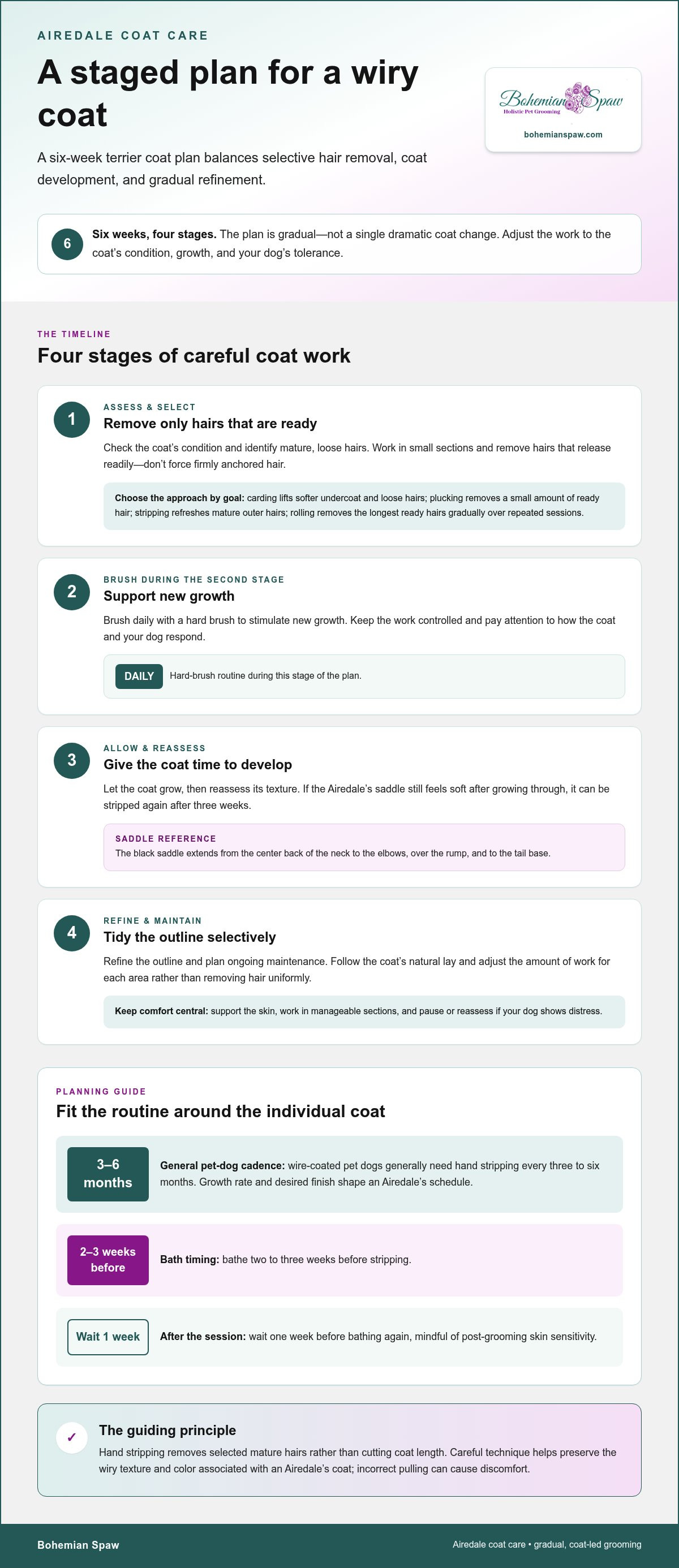
- Use a staged plan to maintain color and texture. A six-week terrier coat plan can divide the work into four stages: assess the coat and remove ready hairs; brush daily during the second stage with a hard brush to stimulate new growth; allow the coat to develop and reassess its texture; then refine the outline and plan ongoing maintenance. If an Airedale’s saddle still feels soft after growing through, it can be stripped again after three weeks. The black saddle extends from the center back of the neck to the elbows, over the rump, and to the tail base.
- Choose a professional familiar with terrier coats. Experience handling wire coats matters because incorrect pulling can make stripping uncomfortable. Look for practical knowledge of coat growth, gentle restraint, and the Airedale’s pattern. A title alone doesn’t show how someone works through a coat, so assess their technique and attention to the dog’s comfort. Hand stripping is a long, careful process, and it may not create a striking before-and-after change.
- Plan frequency and time around the individual coat. Pet dogs with wire coats generally need hand stripping every 3 to 6 months. An Airedale’s growth rate and desired finish shape the schedule. One groomer spent about an hour to an hour and ten minutes stripping an Airedale named Coco; that example illustrates the time involved, not a fixed appointment length.
- Keep comfort central throughout the session. Hand stripping shouldn’t hurt when mature hairs are removed with suitable technique, but incorrect pulling can cause discomfort. Stop and reassess if your dog shows signs of distress; careful handling and small sections help keep the process controlled.
Carding, plucking, stripping, and rolling techniques
Choose a method based on the coat’s condition and the finish you want. Each technique manages different hairs, so careful work in small sections matters.
-
Use carding and plucking techniques
Start by separating a small area and identifying loose, mature hairs. Carding uses a stripping tool to lift softer undercoat and loose hairs without removing every longer guard hair. For plucking, grip a small amount of hair between your thumb and forefinger, then pull sharply in the direction of growth. Don’t take a large handful or tug hair that resists. If your dog seems uncomfortable, pause and reassess.
-
Use stripping and rolling techniques
Strip a section when you want to remove mature outer hairs and refresh the coat’s outline. Rolling takes a gradual approach: remove the longest, ready hairs over repeated sessions, allowing younger hairs to develop between passes. This maintains more than one coat length at a time. Avoid stripping a broad area all at once when the desired finish depends on steady, layered regrowth.
- Work in a consistent direction. Part the coat so you can see the hair near the skin, then use your fingers or a suitable tool to remove only hairs that release readily. Support the skin and work in manageable sections, following the coat’s natural lay. A steady rhythm helps you notice changes in texture and your dog’s response. Don’t force firmly anchored hairs.
- Adapt the technique to the area. Airedale ears need attention on both the inside and outside. Strip the surfaces carefully, avoiding scissors around the edges when possible. The head, body, and legs may need different levels of refinement, so follow the natural outline instead of removing hair uniformly. Check the coat as you work: a balanced result comes from selective grooming, not simply taking off more hair.
- Keep the dog comfortable as you work. Watch for pulling away, repeated turning, or tension during a section. Pause, adjust your hold, or end that part of the session rather than continuing through resistance. Because incorrect technique can make stripping uncomfortable, a professional hand-stripping session can guide the method and pace for your dog’s coat. Explore professional dog grooming services for a considered approach to coat care.
A video demonstrates basic hand-stripping techniques on an Irish Terrier. Use it to observe the general process, but let the coat in front of you guide each pass. A demonstration doesn’t mean every section should be handled identically. Consider the hair’s texture, whether it releases readily, and the outline you want to preserve. Work selectively and pause to reassess rather than continuing automatically.
Compare the areas already handled with those still to be addressed. If the outline looks uneven, slow down and refine it with small, careful passes rather than removing a lot of hair at once. Recheck the coat and your dog’s response as you work. This keeps the technique responsive to the coat instead of turning hand stripping into a fixed sequence of motions.
Hand-stripping tools and their uses
For hand stripping an Airedale Terrier in Lisle, match each tool to the task rather than treating brushes and blades as interchangeable. The right choice depends on whether you’re lifting loose undercoat, removing mature guard hairs, or refining the outline.
- Start with your fingers for controlled plucking. Separate a small patch of coat and identify hairs that are ready to release. Grip a small amount between your thumb and forefinger, then pull sharply in the direction of growth. This lets you control each pull and feel whether the hair comes away readily. Don’t twist, rake, or take a large handful, as these movements can tug the skin and cause discomfort.
- Choose a stripping knife for carding or coat work. A stripping knife can lift loose hairs and undercoat with a light, controlled motion. Support the skin and work on a small section at a time. The tool should guide loose hair out, not cut through the coat. Avoid pressing its edge into the skin. For detailed work, your grip and direction matter as much as the tool itself.
- Use an undercoat rake to address dense undercoat. Groomers often use this tool on breeds such as Airedales. Move it gently through the coat, following its natural lay, and stop if it meets resistance. An undercoat rake targets undercoat; hand stripping removes selected mature outer hairs. Using the right tool for each layer helps avoid repeated, rough pulling through the same patch.
- Keep a hard brush for between-stage coat care. During the second stage of a staged terrier coat plan, brush daily with a hard brush to stimulate new growth. Use steady strokes and check that the coat lies smoothly afterward. Brushing supports coat maintenance; it doesn’t selectively remove mature hairs like fingers or a stripping knife. Don’t force a brush through tangles or turn brushing into pulling.
- Reserve scissors and clippers for distinct finishing choices. They cut hair rather than extracting mature hairs, so they don’t do the same job as fingers or a stripping knife. For hand stripping an Airedale Terrier in Lisle, choose tools to suit the coat area and desired finish. Carefully strip both sides of an Airedale’s ears, avoiding scissors around the edges when possible. Keep tools clean, work in good light, and compare both sides as you shape the outline. If a tool snags or your dog resists, pause.
Airedale Terriers and other wire-coated breeds
Build a grooming rhythm around coat growth, lifestyle, and the finish you want. Airedales share wire-coat care needs with other terriers, but each dog’s coat develops at its own pace.
- Assess the coat before setting a schedule. Part the coat and compare the outer hairs with the undercoat. Mature, loose hairs are ready for removal; newly growing hairs need time to develop. A puppy can grow an excellent coat in three weeks, while an adult dog usually takes eight to ten weeks. Use these growth patterns as context, then schedule the next session based on the coat’s actual condition.
- Follow the Airedale’s pattern when planning the work. Identify the saddle, the black area that extends from the center back of the neck to the elbows, over the rump, and to the base of the tail. Assess the coat across this pattern instead of treating the body as one uniform surface. If the saddle still looks soft after growing through, it can be stripped again after three weeks. This focused reassessment helps preserve the intended texture.
- Schedule pet-coat maintenance by growth and daily life. Pet dogs with wire coats generally need hand stripping every 3 to 6 months. Choose the interval by noticing when the coat loses its crisp feel or looks overgrown, while considering how much upkeep suits your household. Terriers should be worked over several weeks, with the schedule adjusted to each dog’s growth. A gradual plan avoids treating every area as though it matures together.
- Separate a companion-dog finish from show preparation. A pet terrier’s practical outline can take priority over a precise show pattern. Show dogs are plucked weekly, often across multiple days per week, and groomers may leave a stripped section for 6 to 8 weeks while staging the coat. For a dog being exhibited, the cheeks and throat can be stripped within a day or two of the show. Keep that close timing tied to the show goal, not ordinary pet maintenance.
- Adjust the routine for each wire-coated dog. Whether you have an Airedale or another terrier, inspect the texture, identify mature hairs, and plan the next session around regrowth. A six-week staged plan can organize terrier coat work into manageable stages, but it isn’t a fixed timetable for every dog. Daily brushing during the second stage supports new growth; the dog’s coat condition determines when the next area is ready.
Bathing before and after stripping
Prepare your Airedale by bathing two to three weeks before stripping, then waiting one week afterward before the next bath. Keep the coat’s condition and your dog’s comfort in mind throughout the grooming routine.
-
Bathe before stripping
Schedule a bath two to three weeks before the stripping session to give the coat time between washing and hair removal. During that interval, notice how the coat settles and whether your Airedale’s skin looks comfortable. Don’t move the bath closer to the appointment just to make the coat feel freshly washed. Gently brush through the coat beforehand and note any sensitive areas so they can be handled thoughtfully during grooming.
-
Bathe after stripping
Wait one week after stripping before bathing your dog. Hand stripping can leave skin very sensitive for several days, so avoid washing during that period. Pay attention to how your Airedale responds to ordinary handling, especially around the areas groomed. If your dog seems uncomfortable, avoid prolonging routine brushing or washing. Give the skin time to settle before returning to the bath routine.
- Plan the appointment around the bath interval. Mark the bath date first, then count forward two to three weeks to schedule stripping. Record the session date and leave one week before the next bath. This simple sequence keeps the two grooming tasks from crowding together. If the coat is worked in stages, track each session so bathing stays coordinated with the areas being stripped.
- Prepare with a calm, practical coat check. Before the appointment, look over your Airedale’s saddle, legs, and head for changes in texture or areas your dog guards. Share what you notice at the start so the groomer can work at a measured pace. Keep the pre-session bath within the recommended interval; a last-minute wash doesn’t replace a careful coat assessment. After stripping, handle your dog gently while the skin settles.
- Keep the next step focused on coat care. If you want professional help coordinating the stripping and bathing routine, choose a grooming session suited to your dog’s coat. Hand stripping is a detailed process, and the bath schedule is part of its care. Explore dog grooming services to plan the next coat-care step with your Airedale’s needs in mind.
Treat the timing as a firm part of the grooming plan rather than an afterthought. The recommended interval is 2-3 weeks before stripping, with bathing delayed until one week after stripping. Keep the plan easy to follow by noting the intended bath and stripping points together, and check the timing before making changes to either appointment. If someone else helps care for your Airedale, share the schedule so the routine stays consistent. When arranging grooming, explain where the bath falls in relation to stripping and ask for guidance if an adjustment seems necessary. This keeps the bathing decision tied to the stripping schedule, without adding extra coat-care steps or changing the recommended interval.
Bohemian Spaw: Full Groom
Bohemian Spaw offers Full Groom appointments when your Airedale needs broader grooming alongside a considered coat-care routine. After learning how stripping methods and bath timing differ, you can decide whether a Full Groom suits your dog’s needs. A Bath & Brush may work for a simpler visit, while a Puppy’s First Groom helps introduce a puppy to grooming. Choose based on your dog’s stage and the care you’re seeking, rather than treating every visit as the same routine.
For help taking the next step, contact Bohemian Spaw to discuss your Airedale’s grooming needs.
Make your Airedale’s coat plan personal
Choosing hand stripping for an Airedale Terrier in Lisle can help you build a more observant grooming routine. Notice how your dog responds to handling, which areas feel comfortable to touch, and how the coat looks between appointments. These observations give you a useful starting point for discussing your preferred finish and the care that suits your dog.
Keep your priorities simple: your Airedale’s comfort, a coat that suits everyday life, and a grooming approach you can maintain. You don’t need a show-style outline for your dog’s coat care to be thoughtful. Start with a clear conversation about your dog’s coat and the hand-stripping approach that fits your goals.
Contact Bohemian Spaw about hand stripping and take the next step toward a coat-care routine that feels right for you and your dog.
With a little attention and a plan shaped around your Airedale, you can move forward with confidence and care.
Frequently Asked Questions
Why Do Some Dogs Have a Wire Coat?
Wire coats are a breed trait shaped by generations of selection for practical work. During the 1800s, terriers helped hunters and farmers search for small vermin, and a coarse outer coat suited their working role. Today, that texture remains part of the characteristic appearance of breeds such as Airedales. For owners, understanding the coat’s texture helps explain why routine care may differ from grooming a smooth-coated dog.
What should I look for when choosing an Airedale hand-stripping groomer?
Choose a groomer who can explain how they’ll adapt the technique to your Airedale’s coat and comfort. Look for calm handling in small sections, attention to your dog’s response, and adjustments rather than pulling through resistance. Ask how they’ll approach the finish you want and listen for a clear, practical explanation. For owners in Lisle and nearby Naperville, Downers Grove, Wheaton, Glen Ellyn, Bolingbrook, and Warrenville, Bohemian Spaw offers hand stripping and other dog grooming services. Discuss your Airedale’s coat and grooming goals with the team when booking.


