

Age isn’t a barrier to learning a new craft. If you’re wondering whether it’s ever too late to start professional grooming, the answer is no: people can develop the knowledge and hands-on skills dog grooming requires at different stages of life. No formal education is required to begin.
It’s natural to wonder whether you can learn grooming techniques, handle dogs confidently, and find a path into the profession that fits your circumstances. Consider the day-to-day work, ways to gain supervised practice, and the training options available. Patience, safe handling, and a calm, compassionate manner matter alongside learning to use grooming tools. Your experience can be a foundation for a new career, not a reason to hold back.
Key Takeaways
- Age alone doesn’t rule out a grooming career; consider the work style and learning path that fit your goals.
- Build practical ability through supervised experience with dogs of different breeds and temperaments, while keeping safety and comfort central.
- No formal education is required, but a training course and certification can help you develop and demonstrate your skills.
- Understand how earnings and job prospects depend on factors such as experience, work setting, and the services you provide.
Choosing a professional grooming career path
If you’re asking, “Is it ever too late to start professional grooming?” age alone doesn’t determine whether the work suits you. Consider the physical tasks, learning environment, and type of grooming role you want.
Starting Without Animal-Care Experience
Prior animal-care experience can help, but it isn’t required to start learning professional grooming. Career changers can build handling knowledge through instruction and supervised practice. Readiness to learn patiently matters more than age. Before choosing a program, compare its curriculum, hands-on practice, learner support, tools, and costs.
Physical Demands and Health Risks
Grooming involves hands-on work, extended standing, repeated movements, and handling dogs that may shift unexpectedly. Scratches, bites, fatigue, and physical strain are possible, so consider the demands before committing. Safe handling, an organized workspace, and sound body mechanics support comfort for both groomer and dog. A measured pace also gives you time to notice when a dog needs a break.
Building Experience and Finding Entry-Level Work
Beginners can practise with family and friends or volunteer at an animal shelter. Supervised exposure to different breeds and temperaments helps develop adaptable handling skills. For entry-level work, seek opportunities to observe experienced groomers and assist with basic care. A puppy’s first appointment can offer an early example of a gentle grooming introduction; puppy grooming helps owners understand that experience.
Choose shampoo to suit the dog’s coat and skin needs, and rinse thoroughly to remove residue. If a dog has a skin concern, seek veterinary guidance when selecting products.
When choosing a groomer, notice how they greet clients, explain care, and handle dogs. A welcoming manner and compassionate treatment can help build trust, even when it’s difficult to assess technical skill at a glance. Clear, respectful communication matters, too.
Developing grooming skills
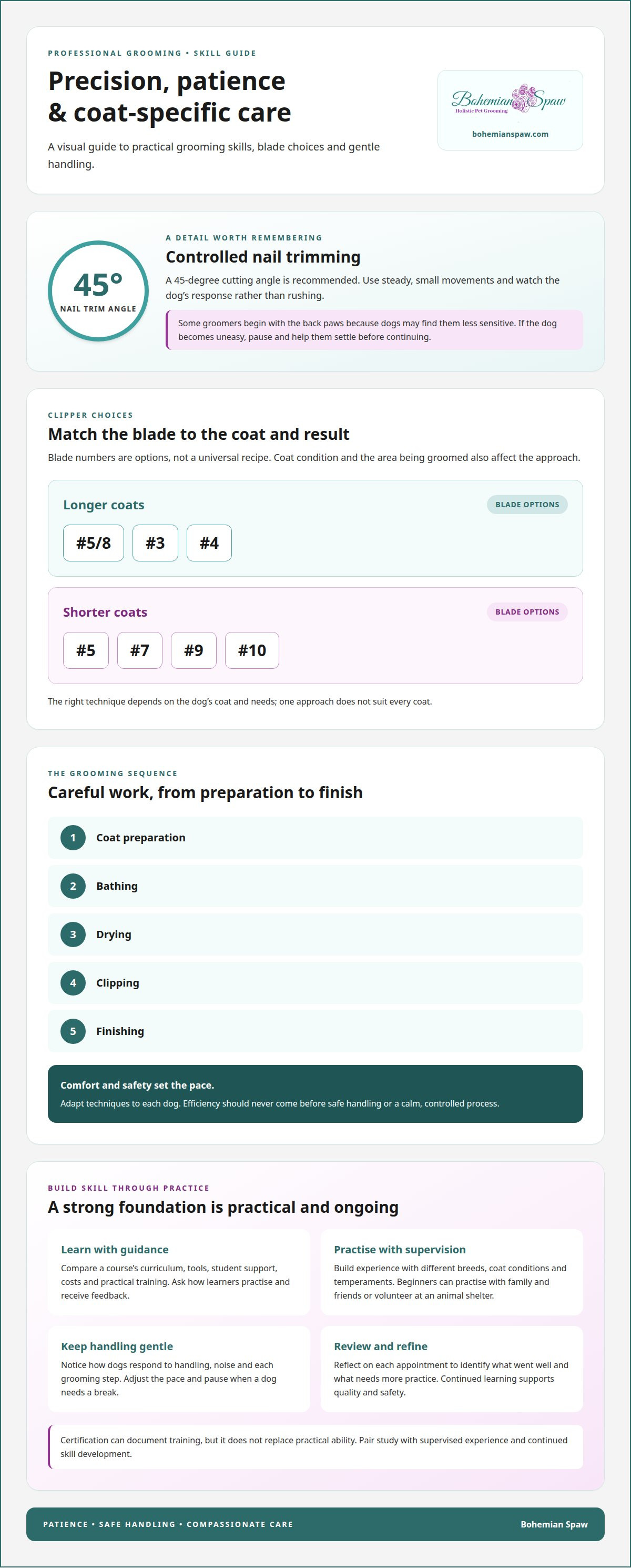
Professional grooming can include coat preparation, bathing, drying, clipping, and finishing, with techniques adapted to each dog. Progress comes from careful practice, learning how different coats respond, and keeping the dog’s comfort central. Efficiency should never come before safe handling or a calm, controlled process.
Clipping decisions depend on coat length and the desired result. For longer coats, blade options may include #5/8, #3, or #4; shorter coats may call for #5, #7, #9, or #10. These numbers describe blade choices, not a universal recipe: coat condition and the area being groomed affect the approach. Studying care needs for double-coated dogs can deepen your understanding of why one technique doesn’t suit every coat.
Nail trimming also rewards controlled practice. A 45-degree cutting angle is recommended, and some groomers begin with the back paws because dogs may find them less sensitive. Work with steady, small movements, observing the dog’s response rather than rushing to finish. If the dog becomes uneasy, pause and regain a settled position before continuing.
Learning continues after a groomer starts working. Keep up with tools and techniques, and observe how dogs respond to handling, noise, and each grooming step. Refining clipper technique, for example, can improve the finish while avoiding unnecessary passes over the coat. Reviewing each appointment helps identify what went well and what needs more practice.
Strong grooming combines precision with patience. Adjusting the pace, controlling tools, and noticing changes in a dog’s comfort help a groomer work consistently. Continued learning supports quality and safety, while a gentle approach can make the experience calmer for the dog.
Training and certification
No formal education is needed to become a dog groomer, but structured training can help turn interest into dependable technique. A course and grooming certification are recommended because they provide a clearer learning path than trying to master every task alone.
Compare courses by their curriculum, tools, student support, costs, and practical training. A useful program connects instruction with hands-on work in bathing, drying, coat preparation, clipping, and safe handling. Ask how learners practise techniques and receive feedback. A course centered on demonstrations can provide a different experience from one with supervised practice.
Certification can document training and show clients or employers that you’ve studied grooming skills, but it doesn’t replace practical ability. A certificate alone can’t show how calmly you’ll work with a nervous dog or adapt to a dense coat. Pair study with supervised practice, then keep developing your technique with different breeds, coat conditions, and temperaments.
Licensing and business requirements can vary by state or city, particularly if you plan to run a grooming business. Treat certification and local business requirements as separate considerations: a credential describes training, while local rules may govern how a business operates. Include the requirements for your location and business setup in your plans before opening a salon or working independently.
Choose a training route suited to your goals. Someone seeking salon employment may prioritize practical instruction and support entering the field; an aspiring business owner should also learn about the local requirements that apply to their setup. Before enrolling, assess the course’s tools and curriculum, then build experience gradually. Aim for a foundation in technique, safety, and compassionate handling, with ongoing learning beyond certification.
What is the average salary and job outlook for pet groomers in the United States?
There isn’t one salary figure that describes every pet groomer in the United States. Earnings depend on location, experience, work arrangement, schedule, and services performed. A salon employee and an independent groomer have different costs and ways of earning, so a national average may not reflect either person’s take-home pay.
To assess possible earnings, distinguish gross income from what remains after expenses. An employee’s pay arrangement may differ from a self-employed groomer’s, who must account for operating costs. For a salon role, consider expected hours and how compensation is structured. For independent work, factor in equipment, workspace, supplies, and client acquisition.
Job prospects vary by location and work setting. Local demand, established salons, and entry-level openings can all affect opportunities. Experience handling different coat types and temperaments may lead to different responsibilities than a beginner can take on while developing core skills. Consider nearby employers as well as the work each position involves.
A practical career comparison starts with a few questions: Is the role employed or independent? What schedule does it involve? Which skills does it require? What costs fall to the groomer? The answers are more useful than treating a national average as a personal forecast. They also help you weigh income expectations against grooming’s physical demands, training, and daily pace.
For a real-world view of the work and its service formats, explore professional grooming services and consider which skills each type of appointment calls for.
Bohemian Spaw
Bohemian Spaw provides professional dog grooming in Lisle for local owners, including those in Naperville, Downers Grove, Wheaton, Glen Ellyn, Bolingbrook, and Warrenville. Exploring grooming as a career and arranging care for your own dog are different steps, but seeing professional coat and hygiene care in practice can make the work more tangible. Services include Full Groom, Bath & Brush, Puppy’s First Groom, and De-Shedding Treatment, with care tailored to your dog’s needs.
If you’re considering this career, keep building your skills through training and hands-on experience. For your dog’s grooming needs, Bohemian Spaw provides a calm, attentive setting focused on their comfort as well as their coat.
Contact Bohemian Spaw to discuss your dog’s grooming appointment.
Let your next step take shape
If you’re still wondering whether it is ever too late to start professional grooming, let curiosity guide your next move rather than age alone. Start with a practical step: learn about the day-to-day work, observe grooming techniques, or seek guided practice. Give yourself room to discover what feels rewarding and where you want to grow. Your first step doesn’t need to define your whole future.
If your interest begins with caring for your own dog, professional grooming offers a close-up view of patient handling and thoughtful coat care. That experience is worthwhile in its own right, separate from pursuing grooming as a career. Choose the path that fits your life now, and let your skills or understanding develop steadily.
Explore grooming care with Bohemian Spaw, and take the next step with confidence in the direction that feels right for you.
Frequently Asked Questions
Is there an age limit for starting a professional grooming career?
There is no fixed age limit for beginning a dog-grooming career. To assess your readiness, consider whether you can manage hands-on work, learn grooming techniques, and treat dogs patiently. Someone changing careers, for example, can start with foundational lessons and supervised practice, then build confidence gradually. Animal-care experience can help, but it isn’t a prerequisite.
What qualifications or certifications do professional groomers need in the United States?
No formal education is required to become a dog groomer. A training course and certification can help build and document skills, but certification is not a substitute for practical ability. Pair coursework with supervised practice handling different coats and temperaments, then keep refining your techniques as new challenges arise.
How long does it take to train as a professional pet groomer?
Training time varies with the course structure, hands-on practice, and skills being learned. Studying clipping alone differs from developing a broader routine that includes bathing, drying, coat preparation, and safe handling. You can progress through lessons while practising under supervision, then continue building skills through varied grooming experience. Focus on demonstrated ability rather than rushing toward a finish date.
What are the differences between grooming school, apprenticeships, and self-study?
Grooming school offers organized lessons, while an apprenticeship centers on observation and supervised work in a grooming setting. Self-study allows independent learning, but practical feedback and safe handling experience can be harder to gain alone. A balanced route may combine coursework with supervised practice. Experience with family dogs or shelter animals can also help you become familiar with different dogs and temperaments.


