

What if a calmer grooming appointment starts with small, gentle steps at home rather than asking your dog to simply “get used to it”? Learning how to prepare a fearful dog for a grooming appointment can feel daunting when you’re worried they’ll panic, pull away, or become more anxious next time. Your concern is understandable, and preparation isn’t a test of obedience. It’s a way to help your dog feel safer, one manageable experience at a time.
A thoughtful routine can build familiarity without pushing past your dog’s comfort. This guide explains how to introduce simple handling practice at home, recognize when your dog needs a break, and share useful details with your groomer before the visit. You’ll also find ways to make appointment day more predictable and choose a grooming service that suits your dog’s needs.
At Bohemian Spaw, grooming considers a dog’s emotional comfort as well as their coat and hygiene. A little preparation and clear communication can help you and your groomer work toward a gentler experience at your dog’s pace.
Key Takeaways
- Learn how to prepare a fearful dog for a grooming appointment with brief, gradual practice that builds familiarity without forcing your dog to continue.
- Match preparation to your dog’s comfort and history, and seek veterinary guidance when fear or handling concerns call for extra support.
- Help make the appointment steadier by keeping routines familiar and sharing your dog’s fears, comfort cues, and handling sensitivities with the groomer.
- Choose a grooming service suited to your dog’s needs. Preparation can make the visit more predictable, but it can’t guarantee a stress-free experience.
- See how Bohemian Spaw’s low-stress, individualized approach in Lisle can complement the care you provide at home.
Why grooming can feel frightening, and what preparation can realistically change
An upcoming grooming visit can bring its own worries: Will your dog pull away when someone reaches for a paw? Will the dryer or bath feel like too much? Preparation can make parts of the experience more familiar, but it can’t promise that every dog will feel relaxed throughout every grooming task.
Grooming brings together sensations and interactions that may be new or uncomfortable: being touched by an unfamiliar person, hearing equipment, standing on a grooming surface, or having certain areas handled. Dog grooming practices include care such as bathing, brushing, and coat maintenance, but a dog experiences each step individually. A bath may be easy for one dog while brushing or nail care feels difficult. Another dog may be unsettled by separation from their person.
What might make grooming feel unfamiliar to a dog?
Paw handling, brushing through a tangle, water on the coat, a dryer’s sound or airflow, and unfamiliar handling can all contribute to unease. Even a dog who enjoys being brushed at home may react differently in a new place, with a different person or tool. A puppy encountering grooming for the first time may have little experience with these sensations. Bohemian Spaw’s Puppy's First Groom page is relevant for owners considering how an early grooming experience can introduce the process.
Look at the whole situation rather than assigning a meaning to one behavior. Pulling a paw away or turning from a brush tells you to pay attention, but a single response doesn’t establish exactly what your dog is feeling or why. Temperament, past experiences, the task, and the setting can all shape a dog’s reaction. Comfort may also vary from one grooming step to another.
Preparation is progress, not a promise
A realistic aim is to help your dog experience manageable, familiar steps and give the groomer a clearer picture of what your dog finds comfortable. A practice session might make a brush feel less surprising without making a bath or dryer familiar. If your dog has an established fear, one attempt at home may not change that history. Small signs of increased comfort can still be useful information.
“Gradual preparation means introducing grooming sensations in small, comfortable steps, not expecting a dog to endure everything at once.”
Forcing a dog to stay still through handling they’re trying to avoid may make the experience harder, not teach them that it’s safe. Treat discomfort as a cue to pause, reduce the challenge, or stop for now. The next sections explain how to build gentle practice, choose an approach that fits your dog, and share useful details with the groomer. Progress means creating more predictability and communicating needs clearly, not measuring success by a perfectly calm appointment.
Build positive grooming associations with short, gradual practice at home
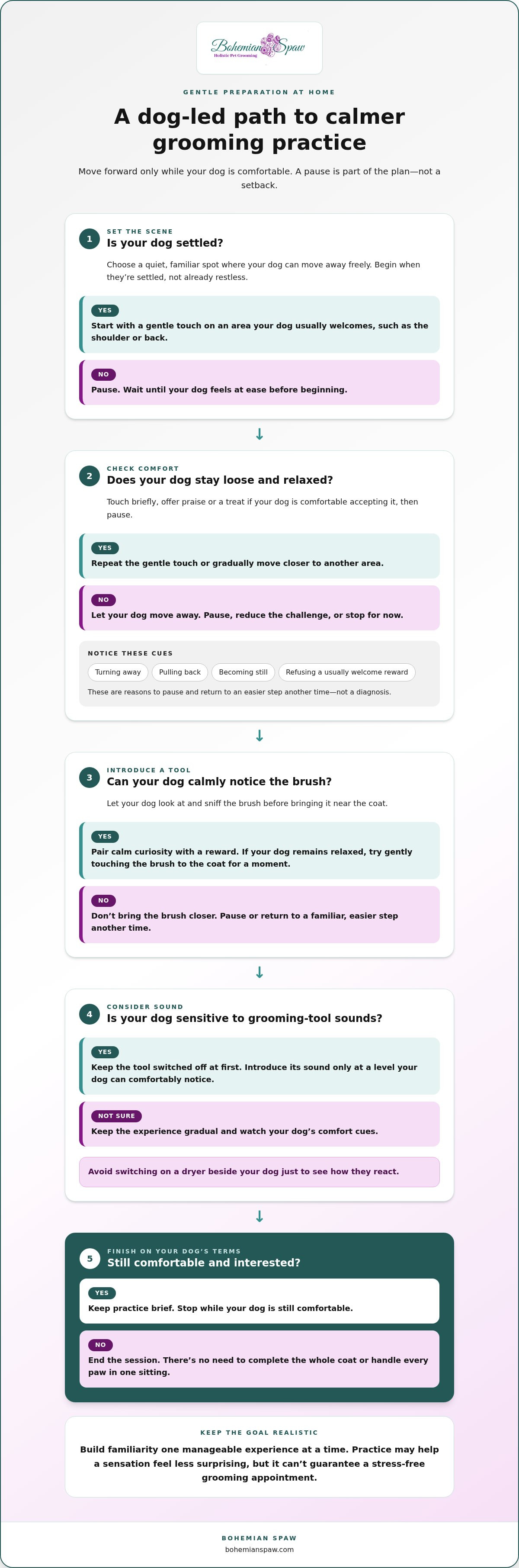
Home practice works best when it feels like a small invitation, not a miniature grooming appointment. Choose a quiet, familiar spot where your dog can move away freely. Keep rewards nearby, and begin when your dog is settled rather than already restless. The aim is to let your dog notice a sensation, enjoy something pleasant, and have the choice to pause.
Start with touch your dog already accepts
Begin with a gentle touch on an area your dog usually welcomes, such as the shoulder or back. Briefly touch, offer a reward, then pause. If your dog stays loose and relaxed, repeat or gradually move closer to another area. Treat paws, ears, face, and tail as separate steps, not a sequence to complete in one sitting. If your dog moves away, let them; choice helps keep practice comfortable.
Introduce grooming tools one small step at a time
Let your dog look at and sniff a brush before you bring it near their coat. Pair calm curiosity with a reward. Later, you might touch the brush gently to the coat for a moment, reward, and stop. For a sound-sensitive dog, keep a tool switched off at first. Introduce its sound only at a level your dog can comfortably notice. Don’t switch on a dryer beside your dog to see how they react.
A simple practice sequence might look like this:
- Settle: Wait for your dog to feel at ease in the practice space.
- Touch briefly: Start with a familiar area and a light touch.
- Reward: Offer praise or a treat if your dog is comfortable accepting it.
- Introduce a tool: Let your dog notice the brush, then try brief contact only if they remain relaxed.
- Pause: Finish before your dog loses interest or becomes uneasy.
Gradual desensitization pairs small exposures with safety, so a dog can become familiar with a grooming sensation without being pushed to endure it. The Fear Free Pets initiative also shares education focused on reducing fear, anxiety, and stress in pets. Take your cues from your own dog: turning away, pulling back, becoming still, or refusing a usually welcome reward can be reasons to pause and return to an easier step another time. These are signals to observe, not a diagnosis.
Keep practice brief and stop while your dog is still comfortable. There’s no need to brush the whole coat or handle every paw in one session. Repeating a simple step across separate opportunities can be more useful than trying to accomplish everything at once. This approach can be especially helpful for young dogs. A gentle puppy’s first grooming experience can be an introduction rather than a test.
If you’re preparing for a visit in Lisle, Bohemian Spaw’s individualized dog grooming approach can complement the familiar, low-pressure practice you build at home.
Choose the right preparation approach for your dog's fear and history
There isn’t one preparation plan that fits every dog. A dog who accepts brushing but pulls away when a paw is touched may benefit from careful practice focused on that specific step. A dog who becomes intensely distressed, snaps during handling, or takes a long time to recover needs a different conversation, not more pressure to “get through it.” The next step depends on what your dog can currently tolerate and how their reactions are changing.
When home practice may be a useful first step
Gentle practice can be a reasonable starting point if your dog accepts some touch and shows unease around a particular grooming task. Note what they manage comfortably now, such as a brief brush stroke along the back, and what feels difficult, such as paw handling. Change just one element at a time. For example, keep the tool and location familiar while moving contact slightly closer to the sensitive area.
Taking notes helps you avoid guessing. Record the grooming step, what your dog did, and what helped them settle. If a change brings more tension or avoidance, return to an easier version rather than repeating the harder step. Gradual home practice is preparation, not a substitute for support when distress is persistent or severe.
When to involve the groomer or veterinarian
Share your dog’s history with the groomer before the visit if handling has led to intense distress, snapping, or difficulty settling afterward. Describe what happened plainly, including the specific task and any approaches that helped or made things harder. This gives the groomer useful context for discussing your dog’s needs and a suitable grooming plan. It isn’t a request to push through a reaction.
If fear appears suddenly, seems unusually strong, or occurs alongside signs that handling may hurt, seek veterinary advice. Pain or another health concern can affect how a dog responds to touch, and a veterinarian can help assess that possibility. For questions about medication to support grooming, speak with your veterinarian rather than trying a product or dose on your own.
It can be tempting to think that continuing despite fear will teach a dog to accept grooming. Forcing uncomfortable handling may intensify distress and make future care harder. A calmer approach respects the dog’s limits while keeping grooming needs in view. For how to prepare a fearful dog for a grooming appointment, use this guide to decide where to begin:
- Some touch is comfortable, one task is difficult: Try gentle practice focused on that task, changing one element at a time.
- Past handling caused a strong reaction: Tell the groomer what happened and discuss your dog’s needs before the appointment.
- Fear is new, unusually intense, or may involve pain: Seek veterinary guidance before increasing handling practice.
No single technique suits every dog, and home practice shouldn’t replace medical advice. Think of the next step as a partnership: observe your dog, share what you’ve learned, and choose an approach that supports both comfort and safe care.
Make grooming appointment day calmer with a clear plan
A familiar routine can steady the hours around a grooming visit, even if the appointment itself still feels new to your dog. Think of the day in four stages: before leaving home, arrival, handoff, and recovery. Planning each stage helps you focus on what you can control and gives the groomer useful context for your dog’s care.
Share useful details before the appointment
Write down details that could shape the visit: past grooming experiences, specific triggers, handling your dog currently tolerates, and what helps them settle. Be precise and honest. “She accepts brushing along her back but pulls away when her paws are touched” gives a clearer picture than “She’s doing much better.” Include important handling to avoid and share these notes with the salon before arrival.
Keep your summary practical. Mention whether your dog is more comfortable with a familiar voice, a treat, or a pause between handling steps, if you’ve observed that. Don’t present a brief home practice as proof that a difficult task will now be easy. The goal is to give the groomer a useful starting point, not predict exactly how your dog will respond.
Keep arrival and the transition home predictable
Allow enough time to arrive without rushing, and follow the salon’s arrival instructions. A calm, concise handoff can be easier than a long goodbye that keeps your dog’s attention on your departure. Share any last-minute change in your dog’s comfort or behavior, then let the groomer guide the transition according to the salon’s process.
Afterward, make room for a quiet reset at home. Offer water and a familiar resting place, and let your dog choose whether to nap, seek company, or have some space. Notice how they settle without assuming that one reaction tells the whole story. If your dog seems unusually distressed or doesn’t return to their usual behavior, make a note to share with the groomer before a future visit.
Use this checklist to keep the day simple:
- Routine: Keep the lead-up familiar and avoid adding unnecessary changes.
- Arrival: Leave time for an unhurried transition and follow the salon’s instructions.
- Handoff: Briefly share triggers, comfort cues, tolerable handling, and what to avoid.
- Recovery: Offer a quiet place at home and observe how your dog settles.
Learning how to prepare a fearful dog for a grooming appointment includes preparing yourself to communicate clearly, not just preparing your dog. Bohemian Spaw’s first-visit information can help you plan what to share and make arrival feel more familiar.
Find a gentle grooming partner in Lisle for your fearful dog
Home preparation is one part of the picture. A grooming partner who listens to what you’ve observed can carry that care into the appointment, with your dog’s comfort considered alongside coat and hygiene needs. No salon can promise that a fearful dog will feel calm through every step, but clear communication gives the groomer a more thoughtful place to begin.
Bohemian Spaw is an independently owned, dog-focused grooming salon in Lisle, founded as a low-stress alternative to high-volume grooming. For owners learning how to prepare a fearful dog for a grooming appointment, that individual attention can complement gradual practice at home. Your notes about what your dog accepts, avoids, or finds reassuring help make the visit more informed and personal.
What a supportive grooming partnership looks like
A supportive partnership starts with listening. Share specific details you’ve noticed, such as which areas your dog is comfortable having brushed and which handling steps are difficult. That information can guide a conversation about grooming needs and services, whether you’re considering a Bath & Brush, Nail Grinding, or a Full Groom. Choose based on the care your dog needs, rather than expecting every dog to follow the same path.
Bohemian Spaw’s approach centers on individualized dog grooming rather than a one-size-fits-all experience. You can explore its dog grooming services and read a gentle grooming guide for difficult dogs for more context. A careful approach supports comfort, but it doesn’t guarantee that fear will disappear or that every grooming task will feel easy.
Prepare for a local visit in the Lisle area
Bohemian Spaw serves Lisle and nearby communities, including Naperville, Downers Grove, Wheaton, Glen Ellyn, Bolingbrook, and Warrenville. Before your visit, consider what care your dog needs and jot down any important handling concerns or comfort cues. A concise, honest description helps create a useful starting point, even if your dog’s comfort varies from one task to another.
You don’t need to have every answer before taking the next step. Review the grooming options, then share what you’ve learned about your dog so their needs can be part of the conversation. If you’re ready to explore a local grooming visit, explore grooming at Bohemian Spaw at a pace that feels right for you and your dog.
Take the next step at your dog’s pace
Your dog’s comfort can guide what comes next. Notice which parts of grooming feel manageable, and let those observations shape the conversation before the next visit. You don’t have to make every sensation familiar at home or arrive with a perfect plan. A few clear notes about what your dog accepts, avoids, and finds reassuring can help your groomer understand where to begin.
Learning how to prepare a fearful dog for a grooming appointment is less about controlling every moment and more about creating a thoughtful partnership around your dog’s needs. Progress may look different for each dog, and a careful next step is worthwhile even if confidence builds gradually.
If you’re ready to plan grooming with your dog’s comfort in mind, explore grooming services at Bohemian Spaw. Share what you’ve learned and choose a service that fits your dog’s grooming needs.
Frequently Asked Questions
Should I give my fearful dog medication before a grooming appointment?
Only give medication for grooming anxiety if your veterinarian recommends it for your dog. A veterinarian can consider your dog’s health, other medications, and the grooming situation before advising you. Don’t use a human medication, a leftover prescription, or a calming supplement as a substitute for that guidance. If medication is recommended, follow the veterinarian’s directions and let the groomer know what your dog has taken.
Should I cancel a grooming appointment if my dog is scared?
Not necessarily, but don’t feel you must proceed regardless of how your dog is coping. If your dog’s distress is escalating, they can’t settle, or you’re concerned someone could get hurt, call the salon to discuss whether to adjust the plan or reschedule. If the appointment is for an urgent coat or hygiene issue, explain that when you call so you can talk through a sensible next step.
Can a fearful dog still be groomed safely?
Often, grooming can be planned with a fearful dog’s comfort and safe handling in mind, but no approach guarantees every task will be suitable on a particular day. Share your concerns before the visit and tell the groomer if your dog has tried to bite, struggled intensely, or become overwhelmed during past care. The groomer can use that information to discuss what may be manageable and when to pause.
What should I tell the groomer about my dog's fear?
Give concrete examples rather than only saying your dog is nervous. Explain what happened during previous grooming, which situations trigger a reaction, and whether your dog has snapped or tried to escape. Mention health or mobility changes that could affect handling, plus any calming cues your dog recognizes. For families in Lisle, Naperville, Downers Grove, Wheaton, Glen Ellyn, Bolingbrook, and Warrenville, sharing these details early can help set a clearer plan.
Is it helpful to stay with my dog during grooming?
It depends on the dog and how your presence affects them. Some dogs settle with their person nearby; others watch the door, pull toward them, or find it harder to engage with the groomer. Discuss the handoff plan with the salon rather than assuming staying or leaving is always best. If you’re asked to step away, a calm goodbye is usually more helpful than returning repeatedly during the visit.
When should I ask a veterinarian about grooming fear?
Ask your veterinarian if grooming fear begins suddenly, becomes much stronger, or appears alongside possible pain, such as yelping when touched, guarding one area, or moving differently. A checkup can help assess whether a health concern is affecting your dog’s response. Veterinary guidance is also the right place to discuss medication or other support, especially if fear is severe enough to make routine coat or hygiene care difficult.


