
What if a grooming ban is not a verdict on your dog, but a sign that the salon’s setup or approach wasn’t the right fit? If you’re asking what to do if my dog is banned from a groomer Warrenville, it’s understandable to feel unsettled, especially when you don’t know exactly what happened or how your dog will get the care they need next.
A groomer may stop service because of safety concerns, intense fear, or a health issue that makes the appointment too stressful. That doesn’t mean your dog is “bad,” and leaving out the history when contacting another salon could make the next visit harder for everyone. A calm, honest conversation can help you understand the concern and choose a thoughtful next step.
This guide explains how to ask for details about the refusal, what observations may help, and how to prepare for a conversation with another groomer. Bohemian Spaw is an independently owned salon in Lisle serving Warrenville-area owners. You can contact the salon to discuss your dog’s needs before booking, without assuming every dog is a fit.
Key Takeaways
- If your dog has been refused by a groomer in Warrenville, start by calmly clarifying what happened and noting details that could guide future care.
- Compare a follow-up with the original salon, a conversation with another groomer, and professional advice to decide which next step best fits your dog.
- Prepare a concise grooming history that covers past incidents, sensitivities, health concerns, and handling needs before contacting a salon.
- Bohemian Spaw is based in Lisle and serves Warrenville-area customers. A conversation can help you describe your dog’s needs and ask whether the salon may be a suitable fit.
Dog Banned From a Groomer in Warrenville? Start With These First Steps
A grooming refusal can sting, especially when your dog needs regular coat or nail care. Take a breath before responding. The immediate goal is to understand what happened and keep your dog’s comfort and safety at the center of the next decision. Start with a calm, clear account of the salon’s concern.
A refusal is information about a particular service situation, not a diagnosis of your dog. The groomer’s stated policy, the reason they give, and your dog’s immediate welfare should guide what happens next. Listen without arguing, ask for specifics, and write down the details while they’re fresh. If your dog appears hurt or unusually distressed, prioritize their wellbeing rather than trying to continue the appointment.
What to ask the groomer who refused service
Once everyone has had a moment to settle, ask what the groomer observed. Was there a particular handling step, sound, or grooming tool that seemed to upset your dog? Was the concern related to behavior, a possible health issue, or a limitation of the salon’s staffing, equipment, or policies? Fear and defensive responses can have different contexts; this overview of reasons for dog aggression may offer general background, but it can’t explain your dog’s individual behavior.
Clarify what the decision means in practical terms: was service declined for that visit, for a particular grooming task, or under the salon’s policy more broadly? You can respectfully ask whether staff can share relevant incident details or records. They may not have documentation available, so ask without pressuring them. A specific description is more useful than a label such as “difficult.”
What to do before contacting another Warrenville-area groomer
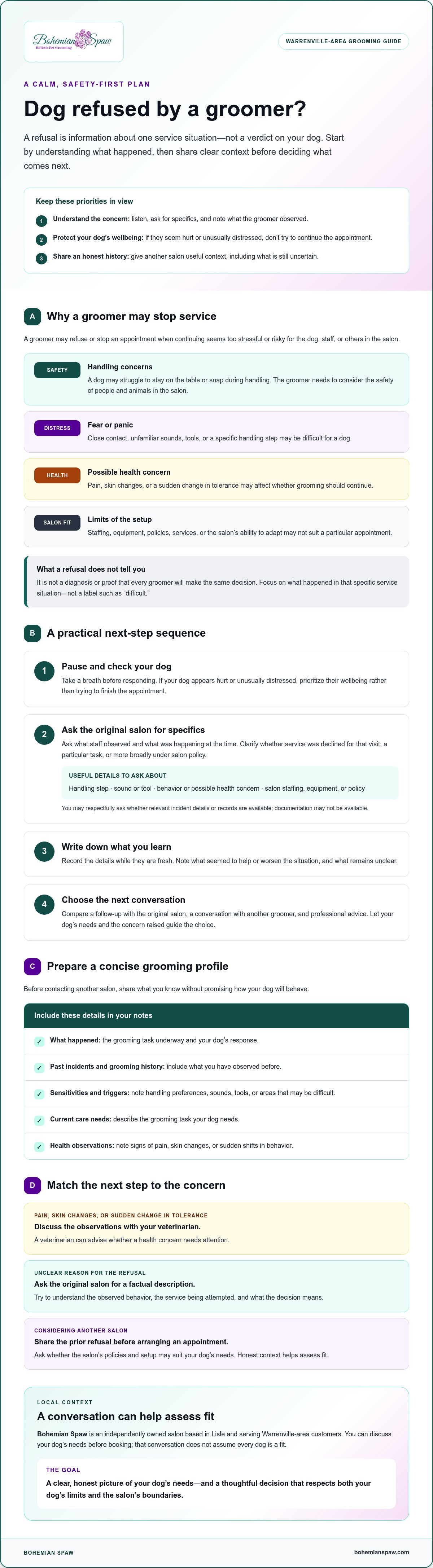
Before reaching out elsewhere, make a short, honest profile of your dog. Note what happened, what was being done at the time, how your dog responded, and what seemed to help or worsen the situation. Include grooming history, handling preferences, triggers, and current care needs. Don’t promise that your dog will behave a certain way; share what you know and what remains uncertain.
- Write down any signs of pain, skin changes, or sudden shifts in behavior. These observations are useful to discuss with your veterinarian, who can advise whether a health concern needs attention.
- Tell a potential groomer about the prior refusal and ask whether the salon’s policies and setup may suit your dog’s needs.
- Keep the conversation factual and open. Honest context helps the groomer assess fit before an appointment is arranged.
You don’t need to settle every question in one call. A thoughtful next step starts with listening, recording what you learn, and choosing an approach that respects both your dog’s limits and the salon’s boundaries.
Why a Groomer May Refuse a Dog, and What the Decision Does Not Mean
A grooming refusal can reflect a concern about the appointment, not a judgment about your dog’s character. Groomers may stop when a dog is struggling to stay on the table, snapping during handling, or showing signs of panic. Close contact, unfamiliar sounds, and grooming tools can make a salon visit difficult for some dogs. Staff need to consider the dog’s welfare as well as the safety of people and other animals in the salon.
That safety-first approach fits a broader commitment to the humane treatment of animals. The USDA page describes the federal role under the Animal Welfare Act; it shouldn’t be read as a specific rule governing every grooming decision. In practice, a groomer may decide that continuing a particular service could add too much stress or risk.
Behavior, distress, and salon safety limits
Focus on what happened rather than settling on a label. Did your dog pull away when a paw was touched, become still and tense near the dryer, or snap when someone tried to brush a sensitive area? These observations can help you explain the situation to another salon. For further context on how grooming approaches can vary, read this guide to gentle grooming for difficult dogs.
Salons differ in their staffing, equipment, policies, services, and ability to adapt an appointment. A groomer may be comfortable with one handling situation but not another, or may not be set up to provide the specific service your dog needs. One refusal doesn’t prove that every groomer will make the same decision. It does mean you should share the details honestly before arranging another visit.
When a grooming concern may need professional input
If your dog’s tolerance changes suddenly, or you notice possible pain or skin changes, contact your veterinarian. A groomer can describe what they observed during handling, but they can’t diagnose the cause. Your veterinarian can assess health concerns and advise whether a qualified behavior professional may be appropriate.
Keep those roles clear: a groomer decides whether the salon can safely provide a particular service, while medical or behavioral questions belong with the relevant professional. If you’re deciding what to do next after a grooming refusal, that distinction helps you choose a path without treating a service decision as a diagnosis. You can also contact Bohemian Spaw with an honest account of your dog’s needs to discuss whether the salon may be a fit. A conversation is not a promise of acceptance.
Compare Your Options After a Groomer Refuses Your Dog
The best next step depends on what prompted the refusal and what your dog needs now. You might need a clearer explanation, a salon with a different setup, or professional input about a health or safety concern. Compare each option by its purpose rather than assuming one path suits every dog.
| Option | Purpose and questions to ask | When it may fit |
|---|---|---|
| Follow up with the original salon | Clarify what happened and whether the refusal applies to a particular service or the salon’s policy. Ask if another approach may be possible, without assuming it is. | When you need details to understand the decision or plan future care. |
| Talk with another salon | Describe your dog’s history and ask about handling policies, services, and the salon’s ability to meet those needs before requesting an appointment. | When you want to explore whether a different salon setup may be a better fit. |
| Seek professional guidance | Ask a veterinarian about possible pain or health concerns, and whether a qualified behavior professional may be appropriate. | When health or safety questions remain unresolved. |
Ask whether the original salon can clarify its decision
A brief, respectful follow-up can fill in gaps, especially if you’re unsure what behavior or service led to the refusal. You might ask, “Was there a particular part of the appointment that raised concern?” or “Is there another service or appointment approach you’re able to offer?” The salon may not have an alternative. If staff confirm their decision, respect that boundary rather than pressing them to work outside their policies.
Consider another salon or professional support
If you contact another Warrenville-area groomer, treat the first conversation as a fit check. Explain what happened, what your dog tolerates, and where you’re uncertain. Notice whether the salon asks thoughtful questions and clearly explains its own limits. Government guidance can also provide useful context: this Los Angeles County resource on grooming facility regulations describes local requirements and practices in that county, so don’t assume its rules apply in Illinois.
At-home brushing or gentle handling practice may help maintain familiarity between appointments, but it isn’t a universal replacement for skilled grooming or veterinary care. The right choice depends on your dog’s needs and each provider’s stated capabilities. If you’re considering a salon conversation, contact Bohemian Spaw to discuss your dog’s situation before booking. Acceptance isn’t guaranteed.
Prepare Your Dog for a More Informed Grooming Conversation
Preparation can turn a difficult experience into useful context for the next provider. Before contacting a salon, gather the details that help someone understand your dog as an individual: what happened, what tends to feel comfortable, and what care they need now. A clear history is more helpful than a promise that the same situation won’t happen again.
Build a clear grooming history for the next provider
Keep your notes factual and concise. Record when the refusal happened, which grooming tasks were underway, what you observed, and what the groomer told you. Include details that may matter, such as whether your dog pulled away during nail care, seemed unsettled by a dryer, or was more comfortable when handled in a particular way.
- Stress signals: Note observable changes, such as turning away, trembling, stiffening, struggling, or vocalizing.
- Comfort and handling: Describe routines or types of handling your dog seems to tolerate, without assuming they’ll respond the same way in a new setting.
- Health information: Share relevant concerns, sensitivities, or care limitations. Follow your veterinarian’s guidance, and ask them about possible pain, skin changes, or a sudden shift in tolerance.
- Grooming history: List past services and any known challenges or helpful approaches, including what you don’t know.
Share the history honestly, even if parts feel uncomfortable. Accurate information helps a salon decide whether it can meet your dog’s needs and explain its limits before a visit is arranged. For practical details about preparing for a salon visit, review Bohemian Spaw’s first-visit information.
Ask useful questions before booking
Policies and options vary, so ask rather than assume. You might say, “What would you need to know to assess whether my dog is a fit?” Then ask how the salon handles breaks, limits a service, or responds if a dog shows distress. Confirm the specific service you’re considering and whether the salon wants any information shared ahead of time. A trial, consultation, adjusted service, or appointment approach may not be available; each depends on that salon’s policies and capabilities.
Bohemian Spaw is an independently owned salon in Lisle serving customers from Warrenville and nearby communities. If you’d like to share your dog’s history and ask whether the salon may be a fit, contact Bohemian Spaw about your dog’s grooming needs before booking. An honest conversation can help you understand possible next steps, without assuming a particular outcome.
Finding a Grooming Conversation Near Warrenville
A refusal can leave you wondering where to turn next. Bohemian Spaw is an independently owned dog grooming salon in Lisle, Illinois, serving Warrenville-area customers. Its low-stress, holistic approach may be worth discussing if you’re looking for a thoughtful conversation about your dog’s grooming needs. The salon also serves customers in Naperville, Downers Grove, Wheaton, Glen Ellyn, and Bolingbrook. A conversation gives you a chance to explain what happened and ask whether the salon’s services and policies may suit your dog. It isn’t a promise of acceptance or an appointment.
What to share when contacting Bohemian Spaw
Keep your first message straightforward. Briefly describe the prior refusal, including the behavior or concern the groomer shared, then outline your dog’s grooming history and current needs. If your veterinarian has offered guidance or care limitations, mention that too. You don’t need to predict how your dog will act. Clear, honest details give the salon a more useful picture of the situation.
It can also help to name the service you’re exploring. Bohemian Spaw offers services such as a Full Groom, Bath & Brush, Tidy Ups, Hand Stripping, Nail Grinding, and selected wellness treatments. Which service, if any, may fit depends on your dog’s needs and the salon’s current policies. Ask what information the team would like before you book, and whether the service you have in mind may be appropriate to discuss.
Choose the next step around your dog’s wellbeing
Think of the exchange as a fit conversation, not a test your dog has to pass. Ask questions, listen to the salon’s boundaries, and allow the team to decide what it can safely provide. If the salon isn’t a fit, you can ask what kind of provider or professional guidance might be more suitable. Discuss health concerns with your veterinarian, while the salon can clarify its own service limits.
If you’re still weighing what to do next, begin with a truthful description of your dog rather than searching for a guaranteed yes. You can contact Bohemian Spaw to discuss your dog’s grooming needs before booking, or review the salon’s dog grooming services to see what may be relevant to ask about. A calm conversation is a practical next step, with your dog’s comfort guiding the way.
Take the Next Step With Your Dog’s Comfort in Mind
A grooming refusal can feel discouraging, but it can also help you understand what your dog needs in a salon setting. Ask the original groomer for clear details, note the behaviors or sensitivities involved, and share that history honestly with any provider you contact. If health concerns or a sudden change in tolerance are part of the picture, speak with your veterinarian before planning the next appointment.
One salon’s decision doesn’t automatically determine what another can offer. The right fit depends on your dog’s needs and the provider’s services, policies, and capabilities.
Bohemian Spaw is an independent dog grooming salon based in Lisle and serving the Warrenville area, as well as Naperville, Downers Grove, Wheaton, Glen Ellyn, and Bolingbrook. The business describes its approach as low-stress, though suitability depends on each dog and the salon’s policies. Contact Bohemian Spaw to discuss your dog’s grooming needs before booking. With open communication and a thoughtful plan, you can take the next step with care.
Frequently Asked Questions
Is it normal for a groomer to refuse a dog?
Yes, it can happen when a salon believes a dog’s distress, behavior, health concerns, or care needs exceed its policies or capabilities. The decision isn’t a diagnosis and doesn’t mean every groomer will reach the same conclusion. Ask what specifically prompted the refusal, note the grooming task and your dog’s response, then use those details in an honest conversation with another provider.
What should I tell a new groomer if my dog was banned elsewhere?
Share the previous salon’s stated reason, which grooming tasks were involved, and what your dog did or seemed to find difficult. Include relevant health concerns, handling preferences, and any guidance from your veterinarian. Keep your account factual rather than apologizing or minimizing what happened. Before booking, ask whether the salon can consider your dog’s needs under its own policies and what information it needs to assess fit.
Can another groomer accept my dog after a salon banned it?
Possibly, but don’t assume a salon will accept your dog before it understands their needs and considers its own policies. Providers may differ in staffing, services, handling practices, and safety limits. Contact another groomer before booking, explain the previous incident honestly, and ask what information would help the salon decide whether an appointment may be appropriate. A refusal from one provider doesn’t automatically determine another’s decision.
Should I take my dog to the vet after a grooming refusal?
Consider contacting your veterinarian if the refusal involved possible pain, a skin concern, a sudden behavior change, or a physical reaction during handling. A veterinarian can assess health questions; a groomer can describe what they observed but can’t diagnose the cause. If the concern seems related to behavior or safety, ask your veterinarian whether additional professional guidance may be helpful before arranging another grooming visit.
Can I groom my dog at home after a groomer refuses service?
Simple, familiar care at home may suit some dogs, but it isn’t automatically a safe substitute for every grooming task. Don’t force handling, introduce unfamiliar tools abruptly, or attempt work that could hurt your dog. Ask your veterinarian about health-related care limits, and discuss your dog’s needs with a qualified groomer. Together, this guidance can help you decide which routine care may be manageable at home.
How do I find a dog groomer near Warrenville for a dog refused elsewhere?
Look for salons serving Warrenville and nearby communities, then contact them before scheduling. Explain the prior refusal, describe your dog’s needs, and ask about relevant services and policies. Bohemian Spaw is an independently owned salon in Lisle serving Warrenville-area customers. You can contact the salon to discuss whether its current services may fit, without assuming acceptance.
What if my dog becomes distressed during grooming?
Tell the groomer about the distress and ask how the salon handles breaks, changes to the service, or stopping the appointment. Don’t insist that staff continue if your dog or others may be at risk. If the distress is new, intense, or possibly linked to discomfort, contact your veterinarian before planning another appointment. Sharing what you observed can help guide a safer, more informed next step.


